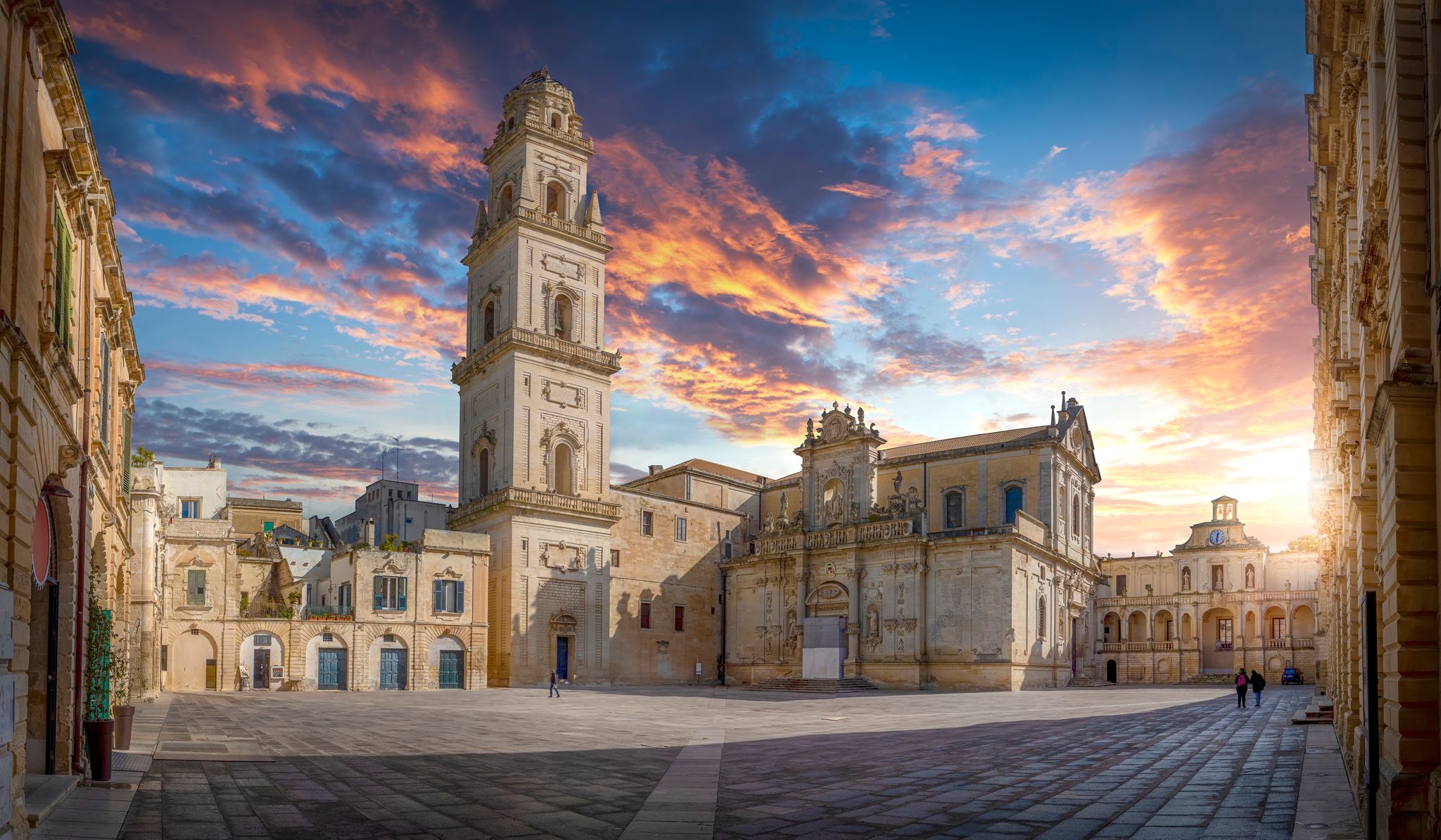
Salento, with its crystal-clear waters, the warm hospitality of its people, and artistic wonders scattered in every corner, is undoubtedly one of the most beloved destinations for both Italian and foreign tourists. This extraordinary land offers a perfect combination of natural beauty, ancient history, and culinary traditions, making it a shining gem of southern Italy.
Once you arrive in Puglia, what should you see in Salento? This historic region of sea, sun, and wind offers a complete journey capable of meeting the expectations of every type of visitor, from young people looking for nightlife to families and retirees seeking relaxation. Let’s take a look at the must-see destinations.
1. Lecce
Salento, wrapped by the breeze of the Ionian and Adriatic Seas, is a Puglian land that is truly extraordinary, an area where the past harmoniously blends with the beauty of the present. If you’re wondering what to see in Salento, the city of Lecce, with its charming Baroque style, is an unmissable stop. Exploring the “Florence of the South,” you can be transported into a Baroque tale, where every architectural detail tells stories of elegance and grandeur.
In Lecce, walking through the narrow streets of the historic center and admiring the sculptures in churches and squares, every step reveals secrets dating back to the Roman and Norman eras. Additionally, strolling through the streets of this part of the town, you can enjoy shopping in elegant little shops and local craft boutiques, filled with handmade works—perfect souvenirs for those who want to bring home unique memories of Salento.
The beating heart of this town is Piazza Sant’Oronzo, one of the first places that answers the question “what to visit in Lecce.” Here, the Column of Sant’Oronzo, standing 29 meters tall, watches over the famous square, emanating a majestic aura and enchanting every visitor.
In the past, the layout of Piazza Sant’Oronzo was different, with the Roman Amphitheater hidden behind 19th-century shops. Today, thanks to subsequent archaeological excavations and the demolition of the area that concealed it, tourists and locals have the chance to admire this historic site dating back to the 1st-2nd century AD. Although only one-third of Lecce’s Roman Amphitheater is now visible, it is worth visiting the site, especially because this monument emerges from the square like a true buried treasure, ready to tell forgotten stories to every passerby.
During the tour in Salento, one must not forget the numerous small churches scattered like gems throughout Lecce, structures that make this town a particularly appreciated destination for lovers of Baroque art. To be enchanted by these architectural beauties, it is essential to visit at least one of Lecce’s three most beautiful churches: the Basilica of Santa Croce, the Basilica of San Giovanni Battista al Rosario, and the Church of San Matteo.
But the Lecce sanctuaries worth visiting don’t end here. The city also hosts the Church of San Niccolò dei Greci, where the ancient Byzantine rite still lives among evocative icons, and the majestic Cathedral of Santa Maria Assunta, Lecce’s main place of worship, which dominates the square of the same name with its imposing presence.
When planning your trip, it is essential to ask yourself not only what to see in Salento but also what to savor in this area of Italy. In Lecce, in particular, between visits it is easy to be tempted by the aromas and flavors of the local gastronomic tradition. In every corner of the city, it is possible to indulge in a lunch or dinner break at one of the many places that offer typical dishes, such as pasta with chickpeas and the Galletto di Sant’Oronzo. In addition, it is inevitable to come across the delicious pasticciotti leccesi, famous sweets filled with a mouth-watering custard wrapped in a crisp and crumbly pastry that can win the hearts of everyone, locals and travelers alike.
And when the desire for relaxation arises, just 10 kilometers from Lecce lie the Maldives of Salento, an unmissable place for those seeking pleasant days by the sea to spend with friends and family.
2. Otranto
Otranto, in the province of Lecce, is another unmissable Salento destination. Overlooking the Adriatic Sea, with its fortress by the sea, olive groves, city walls, and pastel colors that define its silhouette, this town represents a bridge between East and West, a place that holds a millenary history and timeless beauty.
Starting the day exploring the charming historic center of Otranto is ideal for immersing yourself in the ancient stories told by the living stones of the pavement. Specifically, Otranto’s history dates back to theBronze Age and developed during the Messapian era, when this Apulian town represented an important port on the Adriatic Sea. In Roman times, Otranto was one of the most crucial maritime cities in Apulia, but its heyday came during the second Byzantine rule.
Porta Terra, located along a Napoleonic-era bastion, is the main entrance to the town’s historic center and leads to a triangular square dating back to the second half of the 16th century. Continuing on, you encounter Porta Alfonsina, built in 1481 and dedicated to Alfonso, Duke of Calabria, who freed the village from the Ottomans.
Corso Garibaldi proves to be an unmissable stop for those wishing to immerse themselves in an exclusive shopping experience, delighting in the workshops and charming local shops. This elegant avenue stands out as Otranto’s premier commercial artery, leading visitors to the enchanting Piazza del Popolo, dominated by the majestic Clock Tower, built in 1799 and beautifully adorned with the city’s coat of arms.
Continuing along Corso Garibaldi, you reach Porta a Mare via a wooden staircase, which offers a breathtaking view of the harbor. In the heart of the old village, the majestic Aragonese Castle stands as a tangible testament to its history, still marked by the scars of the Saracen bombardments of 1480—an extremely fascinating era definitely worth exploring in depth.
Another treasure not to be missed is the Sanctuary of the Martyrs, built on the site where the eight hundred martyrs of Otranto were beheaded. The Baroque structure, erected in 1614 by Duke Alfonso of Calabria, is dedicated to St. Francis of Paola and preserves the history of the martyrs in an inscription. A evocative place that reflects Otranto’s rich past.
After this dive into history, you can enjoy a moment of relaxation on the crystal-clear beaches adjacent to the town. The beach in the heart of the city offers an oasis of tranquility, while the Alimini Beach, surrounded by a lush pine forest, and the dunes of the Bay of the Turks provide postcard-perfect views.
The day cannot be considered complete without a visit to the Palascìa Lighthouse, perched along the cliffs of Otranto. This lighthouse, one of five in the area, offers a spectacular view and an intimate, peaceful atmosphere, marking the easternmost point of Italy, just 72 km from Albania. Here, amidst wind, sea, and the scents of the Mediterranean, you can witness the very first sunrise of the entire peninsula.
Finally, among the essential stops on the itinerary answering the question of what to see in Salento, the exploration of the Otranto bauxite caves should not be missed—a breathtaking geological site resulting from bauxite mining, a mineral that is an important source of aluminum. The bauxite caves offer every visitor the opportunity to admire a unique landscape characterized by reddish-earth rock walls, blue-green ponds, and vegetation adapted to the particular chemical composition of the soil.
This extraordinary environment creates an exceptionally captivating setting, and the contrast between the colors of the rock walls, the water, and the surrounding vegetation makes the bauxite caves an ideal place to take memorable photographs.
3. Gallipoli
Gallipoli, called “beautiful city” by the Greeks and loved by young Italians and visitors from all over the world, is a charming town located along the Ionian coast—an essential stop if you still don’t know what to see in Salento and want to indulge in fun and seaside relaxation, Puglian style.
The ancient Kalepolis divides its soul into two distinct realities. On one side, the old town, overlooking a fortified islet, with walls and bastions that tell the story of a flourishing commercial port. On the other, the modern city, with sandy beaches washed by crystal-clear waters, the setting for lively evenings. A 17th-century stone bridge connects these two realms, offering a dive into the most authentic Salento.
Travelers arriving in Gallipoli cannot miss the Church of Santa Maria della Purità, overlooking the beach of the same name, which features a striking setting of golden sand and crystal-clear sea, embraced by the city walls. Built between 1662 and 1665, its exterior façade appears simple and white, adorned with three large majolica panels depicting the Madonna della Purità, Saint Joseph, and Saint Francis of Assisi.
Crossing the threshold and stepping inside the sanctuary, the beauty of the stuccoes and paintings covering the walls leaves one speechless, not to mention the 19th-century majolica-tiled floor, a true artistic gem. The nave, although modest in size, houses a marble altar topped by the painting of the Madonna della Purità by Luca Giordano and several 18th-century paintings attributed to Oronzo Letizia and Liborio Riccio. The visit is not only recommended but also free, inviting visitors to take a few minutes for meditation.
Continuing along the Riviera and following the majestic walls of Gallipoli from the Church of Santa Maria della Purità, you arrive at the evocative Angevin-Aragonese Castle. Open to visitors for a modest fee, the castle features grand halls, corridors, and walkways, while the Rivellino Tower is used for summer events and film screenings. The route offers stunning sea views, lined with bars, cafés, and restaurants overlooking the coast. Along the way, you’ll come across several churches, including the Church of San Francesco d’Assisi, the Church of Santa Maria degli Angeli, the Church of the Holy Trinity (Santissima Trinità), and the Church of the Souls in Purgatory (Anime del Purgatorio).
Besides these points of interest, what else is there to visit in Gallipoli? The tour continues with the famous beaches of Gallipoli, including Punta della Suina and Punta Pizzo, which are true seaside paradises for both locals and tourists.
Also not to be missed is a taste of Gallipoli’s culinary specialties, such as Scapece—a distinctly maritime dish made with fried fish, layers of breadcrumbs, vinegar, and saffron—that tells the story and traditions of the local area. The Gallipoli-style fish soup, featuring cuttlefish, mussels, and red prawns, is also a true feast of flavors to be enjoyed with slices of toasted homemade bread and a fine Salento rosé wine.
Finally, it is worth emphasizing that Gallipoli, especially during the summer season, transforms into a lively melting pot of energy with the celebration of numerous festivals and traditional fairs. This charming town attracts not only tourists seeking history, culture, and beach relaxation, but also young Italians and foreigners eager to immerse themselves in a rich calendar of musical events, cultural activities, and nightclub evenings. The city has gained a distinctive reputation in Salento thanks to its venues and unforgettable nightlife events, which have helped make it a truly unique place to visit at least once in a lifetime.